

Most holiday stress is not about any single meal. It is about four or five of them landing inside six weeks, each planned separately, each with its own shop, and the same stock and pastry and cranberry sauce made from scratch three times.
The fix is to plan the stretch rather than the dinners. Map every event onto one calendar in late October, find what repeats across the menus, batch those once in November, and shop by week rather than by occasion.
Start with a list of everything between late November and New Year:
That last line is the one people leave off, and it is why December feels relentless. Twenty-odd normal dinners still need cooking between the events.
Seeing the whole thing written down usually produces one useful reaction: that is more hosted meals than I thought. Better to have that reaction in October than on December 20th.
Now put the menus next to each other and look for the same ingredients doing the same job more than once.
The usual suspects:
Each of those can be made once, in quantity, and frozen. That is the entire trick: the work moves to a quiet weekend in November when nothing is due, rather than onto the three days when everything is.
Planning each event alone is what hides this. Put two menus on the same screen and the repeats are obvious.
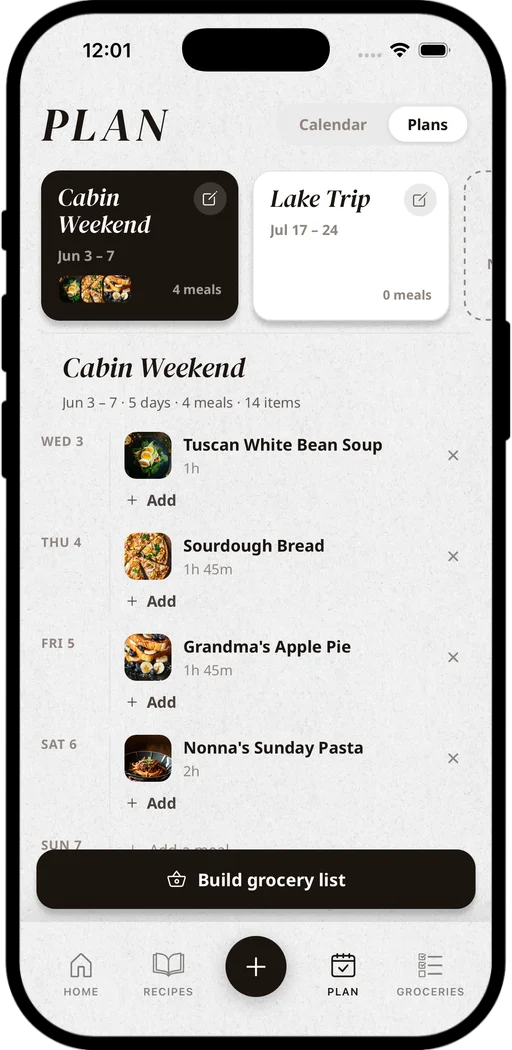
A named plan per event, so the menus sit side by side rather than in your head.
In Tradish you can make a separate named meal plan for each event, with its own dates, which keeps Thanksgiving apart from Christmas apart from the ordinary week. Then you can look at them together instead of remembering them one at a time.
This is the unglamorous step the plan depends on.
Batched stock, dough and sauces need somewhere to live, and most freezers in early November are full of things from last winter that nobody can identify. Clear it before you batch anything, or the batching has nowhere to go and quietly doesn't happen.
While you are in there, label everything that stays. A bag of unidentified frozen beige in January is a bag you will throw out.
Rough shape of a season that works:
Early November — clear the freezer, do the shelf-stable shop, make and freeze the stock.
Mid November — pie dough, cranberry sauce, cookie doughs. Cube and dry the bread for stuffing.
Thanksgiving week — the fresh shop, and the day itself, which is now mostly a bird and some reheating because the gravy base and the pies are already done.
Early December — bake the cookies that keep, like biscotti, gingerbread and shortbread. Our holiday baking schedule has the detail on which doughs freeze and which bake fresh.
Mid December — the exchanges and the gifting, from things already in the freezer.
Christmas week — the second fresh shop, and the day, which looks a lot like Thanksgiving did.
Between Christmas and New Year — the leftovers, the soup, and no cooking you did not choose.

Tradish is launching on iOS and Android soon. A separate plan for each event, and one grocery list per shop rather than one per occasion. Join the waitlist for early access and our best launch price.
Two events in the same week means one shop, not two.
The reason to combine them is the same reason it matters within a single menu: quantities add up invisibly. Two menus each wanting a pound of butter and a pint of cream is three pounds and three pints once the weeknight baking is counted, and discovering that on the Wednesday is how people end up at the shop twice.
Build the week's list from every recipe you are cooking that week, let the shared ingredients combine, and sort it by aisle. Tradish builds that from the plans directly, and you can filter by store if the butter comes from one place and the sprinkles from another.
The most useful part of planning the whole stretch is seeing what is too much while there is still time to change it.
If the calendar has five hosted meals on it, one of them should probably be a potluck, and one should probably be somebody else's house. If three different people are expecting a baked gift, two of them can have the same bake. If the ordinary weeknights have nothing planned at all, that is twenty meals of daily decision-making stacked on top of everything else.
Cutting something in October is a choice. Cutting it in December is a cancellation.
Map the dates in late October, before the invitations start arriving. You are not cooking anything yet, just working out how many hosted meals you have actually signed up for, which is usually more than it felt like.
Write every event on one calendar first, then look for what overlaps. The same stock, pastry, cranberry sauce and bread appear across most of them, so making them once and freezing beats making them four times.
Stock, pie dough, cranberry sauce, cookie dough and breadcrumbs all freeze and all appear repeatedly. Making a large batch in November covers several events without touching the day each one lands on.
Put the menus side by side rather than planning each event alone. Repeats are easy to miss when a menu is written in isolation and obvious the moment two of them are on the same screen.
More than you have, which is why clearing it out in early November is part of the plan. Batched doughs, stocks and sauces need somewhere to live, and the freezer is usually full of last winter's mystery containers.
Every hosted meal on one calendar, the repeats batched once in November, the freezer cleared to hold them, and one shop per week rather than one per event.
Then each individual day gets to be about the day rather than about the four behind it.
Tradish is launching on iOS and Android soon. Join the waitlist to be first to know when we launch.
Related reading: